
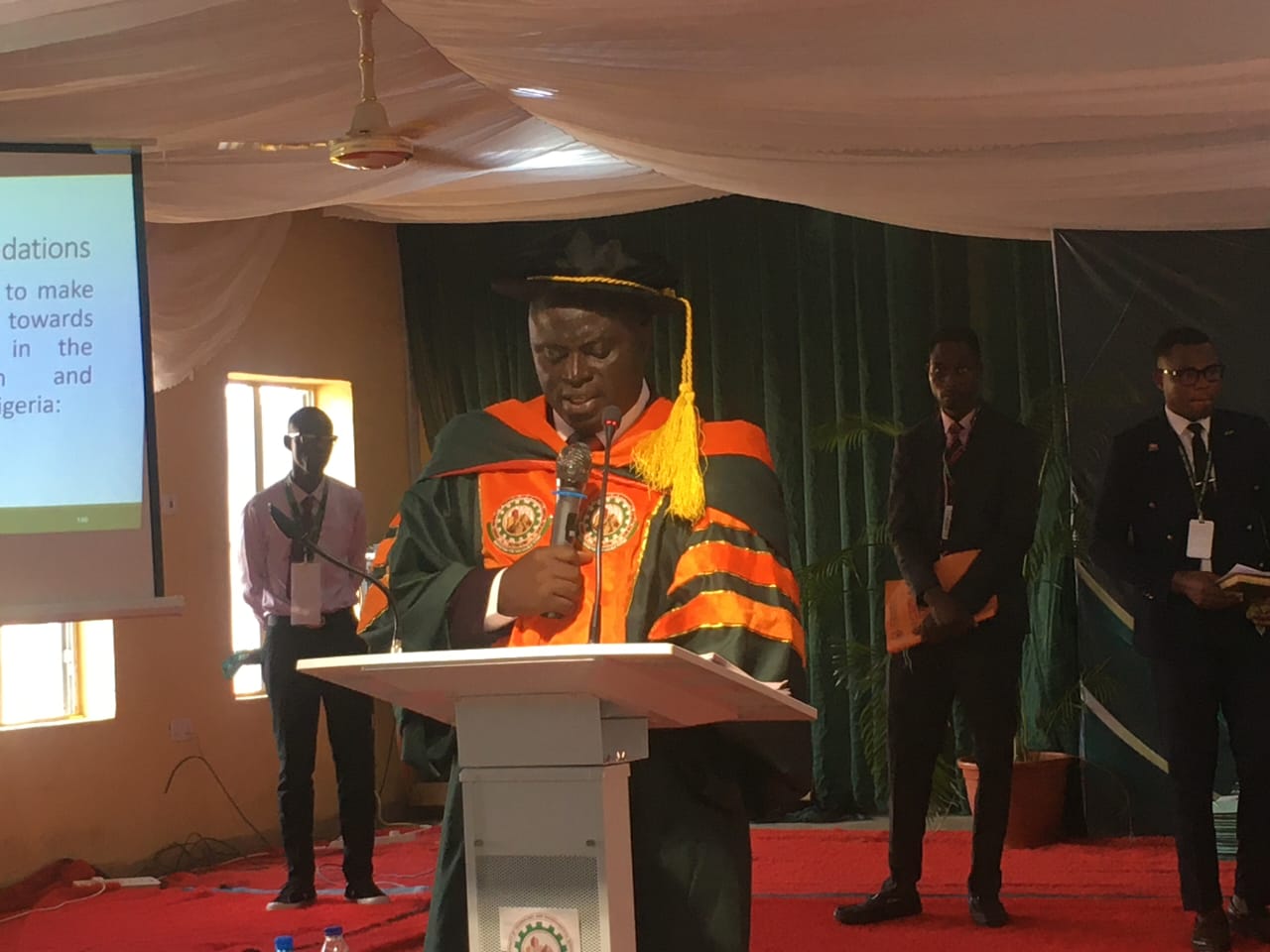
FUTES holds first inaugural lecture, as Don urges FG to review road construction standards
By Kreovant Media
The Federal University of Technology and Environmental Sciences (FUTES), Iyin-Ekiti, has held its first inaugural lecture titled: “Paving the Way to Sustainability: Asphalt Innovations for Safe and Durable Road Pavement”, with a university don calling on the Federal Government to review Nigeria’s road construction standards and embrace more durable and sustainable pavement materials to address the persistent deterioration of roads across the country.
The Professor of Civil Engineering, Olumide Moses Ogundipe, noted that conventional asphalt concrete pavements were vulnerable to failures such as rutting, stressing the need for stronger alternatives, including stone mastic asphalt (SMA), which offers improved resistance to deformation.
Professor Ogundipe urged the government to collaborate with relevant ministries, departments and agencies, academic institutions and industry stakeholders to assess innovative road construction materials and adopt standards that would enhance road durability, reduce maintenance costs and improve the quality of Nigeria’s road infrastructure.
The Don said the adoption of stone mastic asphalt (SMA), which offers greater resistance to rutting, could improve road pavement performance, reduce maintenance costs and extend the lifespan of Nigeria’s road infrastructure.
He noted that Nigerian roads were constructed mainly with asphalt concrete, stressing the need for a comprehensive assessment of alternative materials and technologies that could withstand traffic loads and changing environmental conditions.
According to him, stone mastic asphalt has demonstrated superior resistance to rutting, a common form of pavement failure that occurs when repeated traffic loading causes permanent deformation of the road surface.
He recommended that the government, through relevant Ministries, Departments and Agencies, MDAs, should collaborate with universities, research institutions and industry stakeholders to review the use of SMA and other sustainable materials for possible inclusion in the General Specifications for Roads and Bridges.
Ogundipe also urged the Federal Government to prioritise the exploration and refining of Nigeria’s estimated 42 billion barrels of natural bitumen deposits, describing the resource as an opportunity to reduce construction costs, create jobs and stimulate economic growth.
According to him, sustainable development in highway engineering is essential to addressing the environmental, social and economic challenges associated with urbanisation, climate change and resource consumption.
His words, “Pilot studies are essential to validate the performance of sustainable materials and build confidence among relevant authorities. However, they are expensive and require approvals for field trials and a dedicated facility for accelerated testing. The government should therefore fund the construction of a national pavement test track equipped with heavy vehicle simulators (HVS) to enable accelerated pavement testing.
“Road pavements in Nigeria are constructed mainly with asphalt concrete. Studies have shown that stone mastic asphalt (SMA) offers greater resistance to rutting, a common failure mode on Nigerian roads. It is therefore recommended that the government, through its relevant Ministries, Departments and Agencies (MDAs), and in collaboration with academia and industry, should conduct a thorough review of SMA and other sustainable materials for inclusion in the General Specifications for Roads and Bridges.
“The contracting process should be structured to incentivise contractors who adopt sustainable local materials and technologies in addressing road pavement challenges. Life Cycle Costing (LCC) and Life Cycle Assessment (LCA) should be integrated into the tender evaluation framework to promote sustainable practices that reduce carbon emissions, conserve natural resources, and enhance pavement durability.
“The government, in partnership with the private sector, should fund research on sustainable asphalt pavements and leverage public-private partnerships (PPPs) for the construction of road pavements with sustainable materials.
“Infrastructure development policies must be evidence-based, not driven by individual opinion. To enable this, comprehensive data on pavement construction, distress, failure, and maintenance should be collected and analysed on a regular basis to guide decision-making.
“Nigeria has an estimated 42 billion barrels of natural bitumen deposits that remain largely unexploited. concrete, will ensure a cheaper and more reliable supply, while also generating multiplier effects on construction costs, revenue, job creation, and overall economic growth. It is therefore recommended that the government, in collaboration with the private sector, should, as a matter of priority, commence processes for the exploration and refining of the nation’s natural bitumen resources”.